
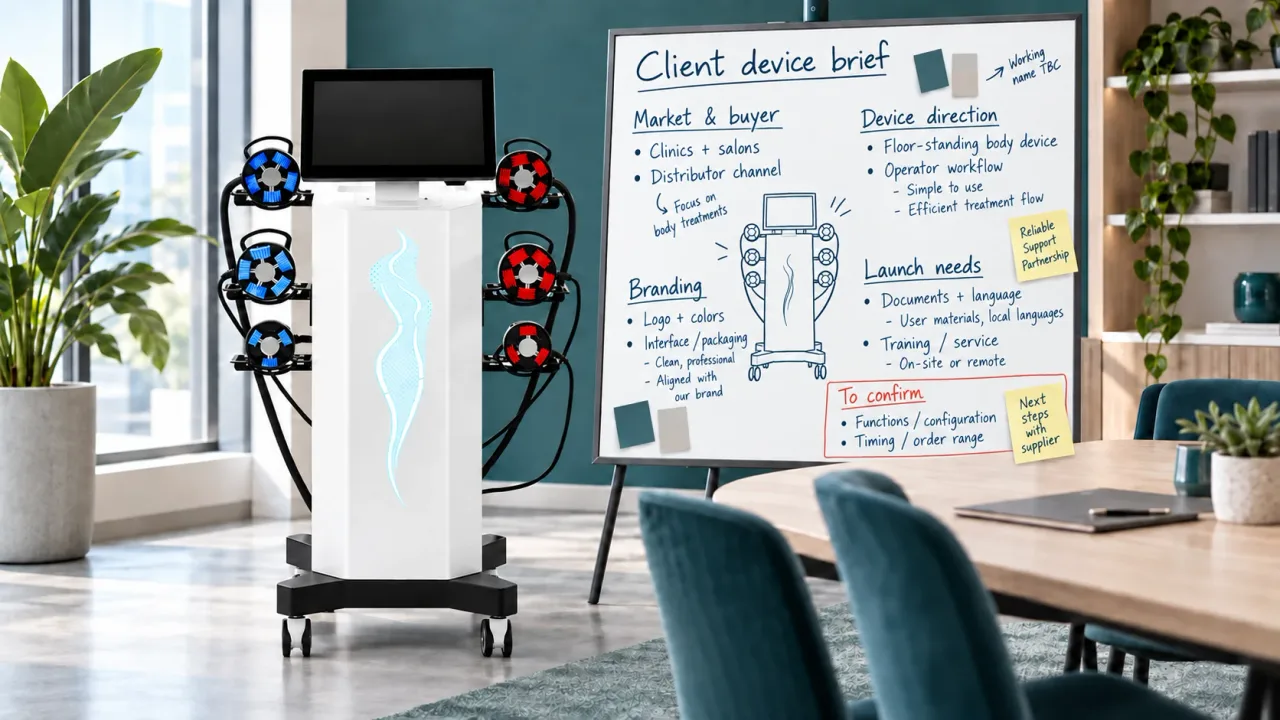
A strong aesthetic device project starts before the first quotation. If a supplier receives only a reference photo and the request “make this with our logo,” the most important decisions are still missing: who will use the device, where it will be sold, what must change and which details remain open.
A short, practical brief gives both sides a clearer starting point. It does not need to be a finished engineering specification. It should make your commercial goals visible and separate essential requirements from preferences.
Why a useful brief beats a long wish list
The purpose of a brief is not to predict every technical answer. It is to help you and a potential partner decide whether to begin with an existing device, adapt a platform or explore a more involved development project. It also prevents a design discussion from drifting away from your market, customer and budget.
Choose a starting path, not a final solution
Before listing features, state how much differentiation your brand needs. These paths involve different levels of design work and decision-making:
- Existing device with your logo: useful when your priority is a clear branded offer built around an established product.
- Private label adaptation: consider the appearance, interface, packaging and supporting materials you want customers to recognize as yours.
- OEM or ODM development: start with a defined product problem and the changes that matter to your market, then discuss technical feasibility.
You do not need to label the project perfectly on day one. Explain the outcome you want, and use the first conversation to test which route fits.
Seven decisions to include in your aesthetic device brief
1. Target market and buyer
Name the countries or regions where you plan to sell and the customers you want to serve. A distributor selling to multi-location clinics may need a different presentation and support package from a brand building a compact range for independent salons. Note the expected sales channel and price positioning without treating an early estimate as a fixed quotation.
2. Product category and intended workflow
Identify the device category, intended professional setting and treatment workflow. Describe the job the device should help an operator perform. If you have a reference product, say what you like about it and what you would change. A reference image is a conversation starter, not a complete specification.
3. Must-have functions and open choices
Separate non-negotiable requirements from optional ideas. List the functions, configuration choices and user experience that matter most to your customers. If you are unsure which technology or configuration is appropriate, state the decision you need help making rather than guessing at a technical parameter.
4. Brand expression
Bring your logo files, brand colors and examples of the visual language you want. Think beyond the cabinet: interface language, labels, packaging and launch materials can affect how consistently the product appears across your channels. Mark which elements must be custom and which can remain standard.
5. Market documentation and claims
List the documents your market or customer may request, plus any labeling or language needs. Ask the supplier what can actually be provided for the proposed device and configuration. Do not assume that a document, certification or permitted claim for one market automatically applies to another.
6. Training, service and ongoing supply
Explain who will install, operate, train and service the device after sale. Ask how training materials, replacement parts, consumables and technical support would be handled. These questions are especially important if your brand will be the customer-facing point of contact.
7. Commercial and project constraints
Share your target launch window, expected order range and any budget boundaries you are comfortable disclosing. These are planning inputs, not promises. Leave room to revise them after the configuration, documentation and development scope are clear.
A one-page brief you can send to a supplier
A first brief can be simple. Use these fields to make the initial discussion productive:
- Brand and contact: company, website, contact person and sales channel.
- Market: countries or regions, target customer and intended professional setting.
- Product direction: device category, reference examples and intended workflow.
- Priorities: must-have functions, preferred features and decisions still open.
- Branding: logo, appearance, interface language, packaging and marketing-material needs.
- Launch requirements: requested documents, training, support and service expectations.
- Commercial context: indicative volume, budget range and target timing, if known.
What happens after the first brief?
A useful supplier response should clarify the proposed starting platform, the changes that may be possible, the questions that need technical review and the information required for a meaningful quotation. The first discussion should narrow uncertainty, not pretend every detail is already settled.
If you are planning a Luxient OEM, ODM or private label conversation, send the brief you have today. A focused starting point is more valuable than waiting for a perfect document.